Tracking what a campaign raised
How a donation gets attributed to a campaign, what the recurring number means, and what neither tells you.
Quick answers
6 questions · click to openCan I see what an email campaign raised?
Yes — campaigns show the donations they generated, alongside opens and clicks.
How is a donation attributed to a campaign?
By the link. Cobber adds a tracking parameter to the links in your campaign, so a donation counts towards it when the donor arrived by clicking through. There's no time window at all.
So someone who donates a week later isn't counted?
Only if they came back through a campaign link. Someone who reads your email, thinks about it, then types your donation page address by hand won't be attributed — and someone who clicks a link months later will be.
How are recurring donations counted?
Separately from one-off gifts, and once at their per-payment amount rather than every month. Ten $20-a-month sign-ups show as $200 of recurring — read it as what the campaign set up, not what it has collected since.
Do refunds come out of the total?
Yes. A refunded payment drops out of every total that counts successful payments, campaign revenue included.
SMS campaigns too?
Yes, the same way — SMS campaigns carry their own revenue and recurring donation figures.
Campaigns show what they raised, which is the number most likely to be quoted at a committee meeting. It’s worth understanding what it counts before you quote it.
How attribution actually works
Cobber adds a tracking parameter to the links inside your campaign. When someone clicks through and donates, that donation is tagged with the campaign.
There is no time window. Attribution is entirely about how the donor arrived:
- clicked a link in the campaign, donated three months later in the same session chain — attributed
- read the email, typed your donation page address by hand an hour later — not attributed
- donated after a phone call that followed the email — not attributed
One-off and recurring are counted differently
| Figure | What it counts |
|---|---|
| Donation revenue | The sum of successful one-off donations attributed to the campaign. |
| Recurring donation revenue | The sum of the recurring donations the campaign set up, at their per-payment amount — counted once, not every month. |
So a campaign that signs up ten donors at $20 a month reads as $200 of recurring, not $200 every month and not $2,400 a year. It’s a measure of what the campaign started, and the ongoing value shows up in your finances over time rather than against the campaign.
What the number doesn’t tell you
Be honest about this when reporting it upward:
- It undercounts. Anyone who gave without clicking a link is invisible to it, and that’s a real share of people — particularly older supporters who read an email then go to your website directly.
- It says nothing about the phone call, the event or the conversation that made someone ready to give. The campaign that gets attributed is often the last touch rather than the persuasive one.
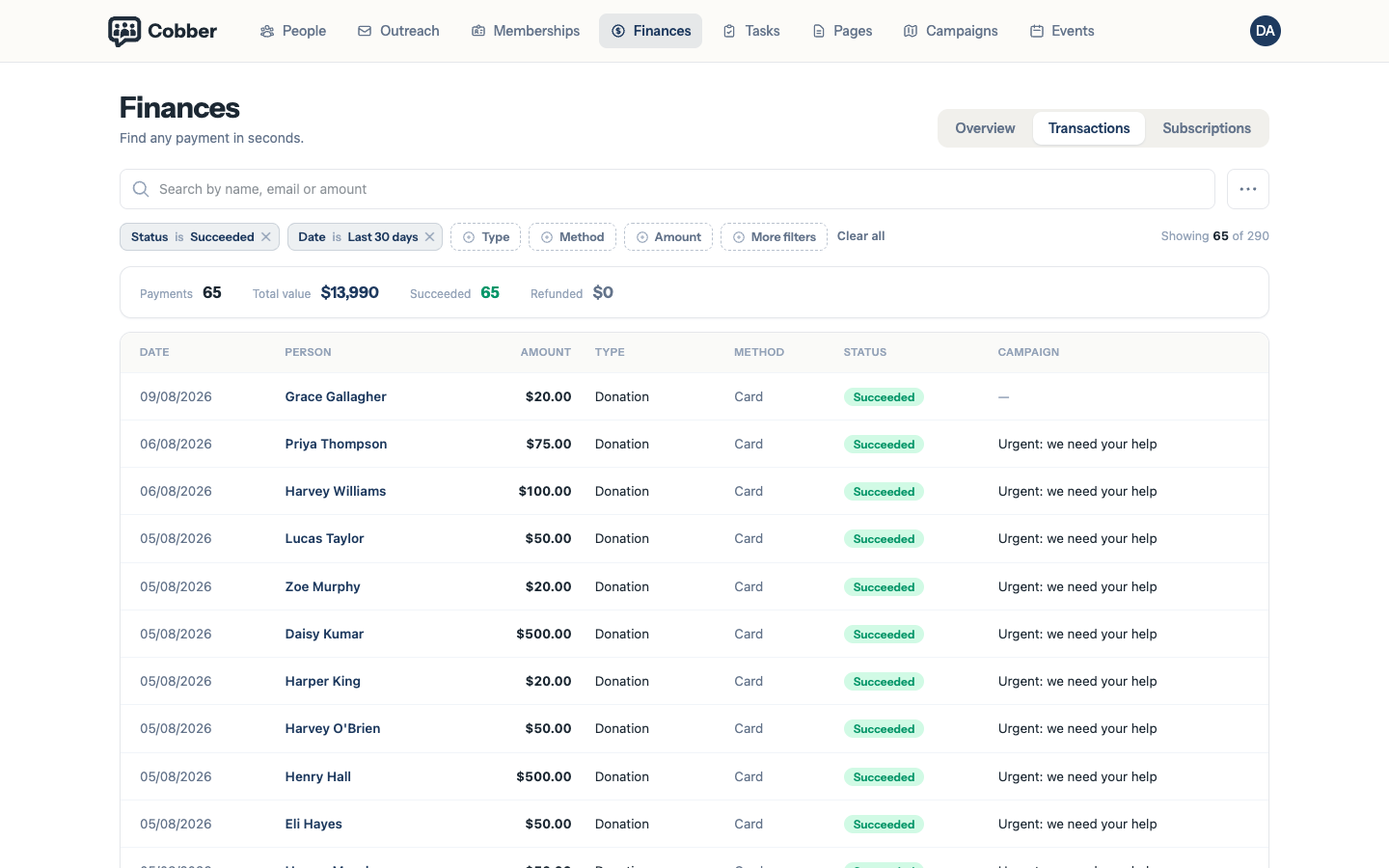
- It’s not a full picture of what you raised. For that, use the Finances screens, which count all money regardless of how it arrived.
Use campaign revenue for comparing campaigns against each other — which subject line, which ask, which segment. That’s what it’s good at.