Running an effective campaign
Close the gap between a newsletter signup and a donation — then use the first three weeks to prove it works.
Quick answers
6 questions · click to openWe’ve got a donation page. Isn’t that enough?
It’s the hardest thing you’ll ever ask for, and most supporters aren’t ready for it. Organisations that only offer donating tend to see the same small group give repeatedly while everyone else stays a name on a list. Put smaller asks in front of it — a petition, an RSVP, a volunteer form — and give people a way to say yes before you ask for money.
What’s the first thing to send?
Not a fundraising email. Send one email to your whole list asking for a signature or an RSVP. You re-establish contact, you learn what your list actually does, and you end up with a group of people who have just said yes — who are the right people to ask for money next.
How many automations do we need?
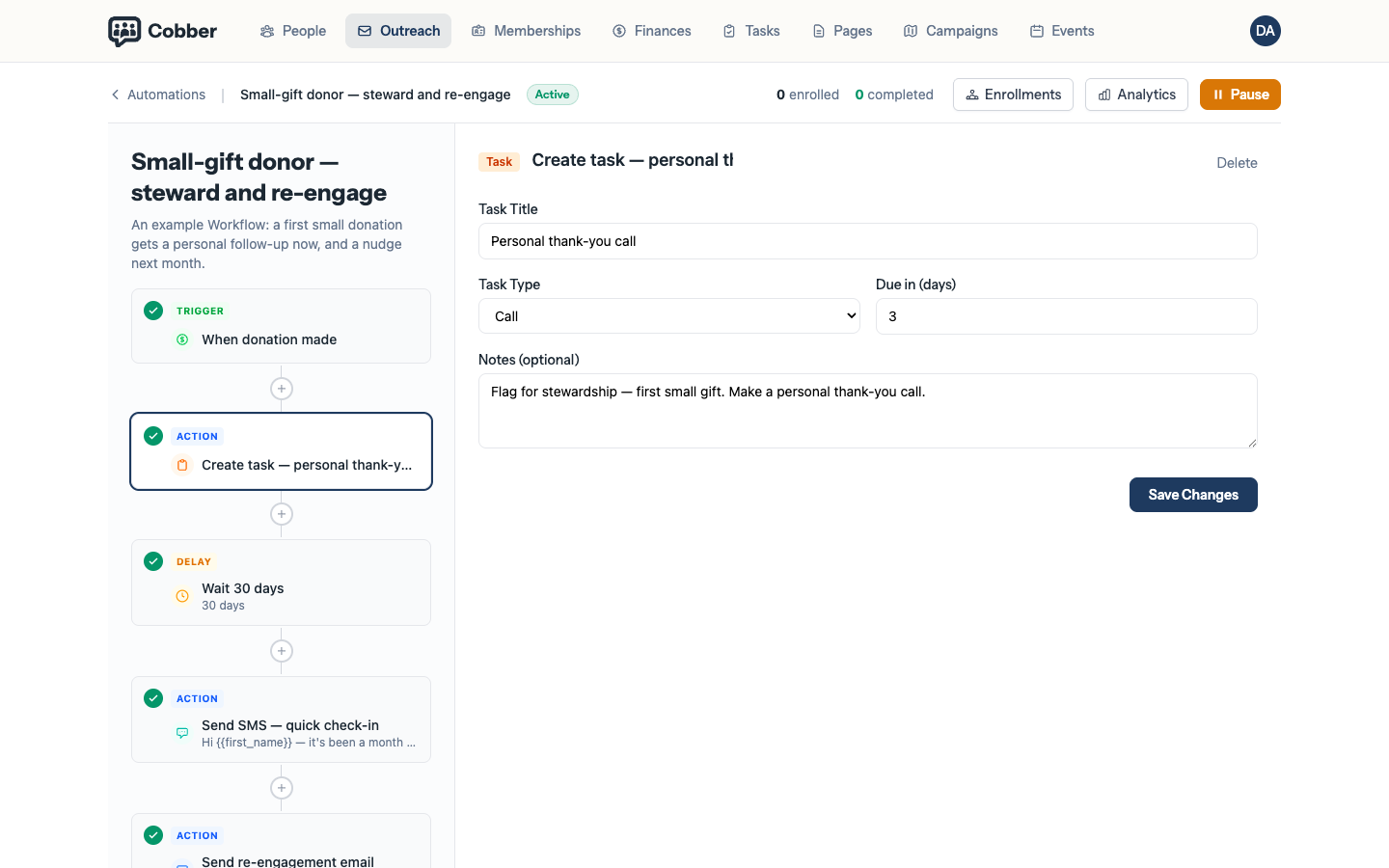
Three is plenty to start, and more than most organisations ever build. Thank a petition signer and ask them to donate a few days later; receipt a donor and ask about monthly giving a month on; welcome a volunteer and create a task for someone to actually ring them.
Is email the whole thing?
No, and the organisations that do best are the ones that pick up the phone. A call campaign turns a list into conversations, and one volunteer ringing twenty people will move more of them than a hundred emails.
How soon should we expect results?
Three weeks is a fair first read. Ask in week one, convert in week two, gather in week three — then count supporters, signatures, money raised and event attendance. If those numbers are flat, the problem is usually the ask, not the tool.
What if our list is old and we’re nervous about emailing it?
Send to your most recently engaged people first rather than everyone at once. A smaller send to people who remember you protects your sending reputation, and it tells you what to expect before you email the whole list.
Most organisations offer their supporters two things: sign up for the newsletter, or make a donation. There’s a long way between those two, and most of your supporters are stuck at the near end of it.
Cobber has everything you need for the middle ground already — petitions, sign-up forms, volunteer forms, events, donation pages, contact forms, and the phone. This page is about actually using them, in an order that works.
Start with a small ask
The pattern we see is an organisation building one donation page and stopping. It’s an understandable instinct, and it caps what you can raise: you’re asking the hardest question first, of people who have never been asked an easy one.
-
Put a small ask in front of the big one
A petition or a sign-up form asks for thirty seconds and a name. Most of your list can manage that. Everyone who signs has just told you what they care about — and given you a reason to talk to them again.
-
Give every page one clear ask
One image, real copy, one thing to do. If a page asks people to donate, volunteer and sign up all at once, most visitors will pick none of them — the decision is harder than any single ask would have been.
-
Make the thank-you do some work
The moment after someone acts is the most engaged they will be all month. A thank-you that just says thanks wastes it. Point at the next thing: signed the petition, now share it; came to the event, now join.
A rough test. Count the ways a supporter can say yes to you this week without reaching for a credit card. If the answer is none, that’s the thing to fix before you write another fundraising email.
Cobber is built for person-to-person campaigning
Email scales, but it doesn’t persuade many people. Conversations do. The organisations that get the most out of Cobber are the ones that use it to put volunteers in front of supporters, not just messages in front of inboxes.
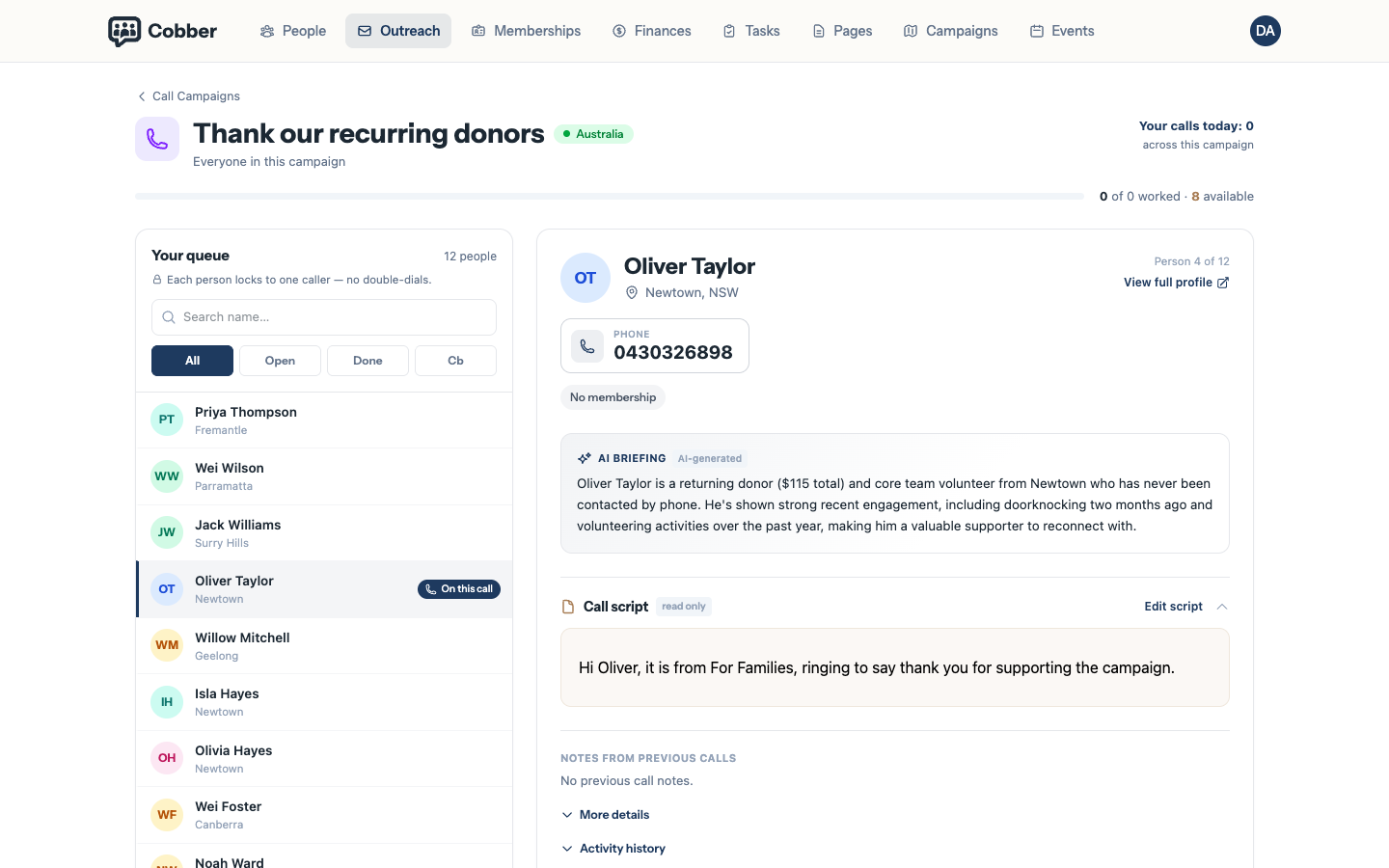
Call campaigns are the clearest example. You build a list, write a script, and your volunteers work through it on a screen that shows them who they’re talking to — membership status, what the person has given or done before, notes from previous calls, and an AI briefing summarising it. They log how the call went in a couple of clicks, including how the person sounded, so you can see which parts of your list are warm and which need work. See call campaigns.
The same instinct applies elsewhere:
- A volunteer signup should create a task for a human, not just an automatic welcome. Volunteers go cold faster than donors, and a phone call within 48 hours is what converts them.
- Organisers can work their own patch. Because roles are scoped to divisions, a local organiser sees their own people and nobody else’s — which is what makes distributed organising possible without handing everyone the whole database.
- Events are the point of all of it. A conversation, then a room. That’s how supporters become the people who run things.
Three automations worth having
Almost nobody builds these unprompted, and they’re the difference between a campaign that runs and a campaign you have to push. Start with three:
| When this happens | Do this |
|---|---|
| Someone signs a petition | Thank them straight away. Wait three days, then ask them to donate — referencing the issue they signed about, not a generic appeal. |
| Someone donates | Receipt them, tag them, and wait thirty days before asking whether they'd make it monthly. Recurring donors are worth many times a one-off, and the ask lands best once the first gift feels good. |
| Someone signs up to volunteer | Welcome them, then create a task for an organiser to ring them within 48 hours. |
The third one is the one people skip because it needs a human. It’s also the one that works best. See automations.
The first three weeks
Three weeks is long enough to learn something and short enough that you’ll actually finish it.
-
Week one — ask
One email to the whole list: who you’re, what you’re fighting for right now, and the one thing you need them to do. Ask for a signature or an RSVP, not money. You’re re-establishing contact and finding out who is still listening.
-
Week two — convert
Your automation is already asking signers to donate. On top of that, send a deliberate email to everyone who signed but hasn’t given, quoting the signature count. Momentum is persuasive, and a number makes it real.
-
Week three — gather
Promote your next event to everyone who has engaged this month, and ring the most engaged rather than emailing them again. No physical event? Run something online. The point is to offer more to the people who are already leaning in.
At the end of three weeks you should be able to say: this many supporters, this many signatures, this much raised, this many coming to an event. Those four numbers tell you whether it’s working — and they’re a far better guide than how busy the month felt.
Then keep going
- Check in a fortnight later. Re-engagement is cheaper than finding new supporters. Email the people who did something and went quiet again, and give them the next thing to do.
- Watch what worked. Campaigns show the donations they generated. Send more of what raised money and quietly stop the rest.
- Keep talking to people. A call campaign every few months to your most engaged supporters will tell you more about what your organisation should be doing than any amount of open-rate data.